- Get link
- X
- Other Apps

The Japanese company Nintendo has played a very important role in the history of the formation and development of modern video games. It was Nintendo that brought the Land of the Rising Sun to the gaming console market. Nintendo at one time set a new level of video game quality with its projects for the Famicom console (in our country known as Dendy). Nintendo has created the most popular gaming console of all times and peoples - Nintendo DS. In the walls of Nintendo was born one of the most recognizable characters of modern video games - plumber Mario. As part of this multi-part material, I will try to tell you in a chronological order about all the game consoles that this Japanese company has released, as well as about the most interesting moments of its history. I hope my story will seem interesting and somewhat informative.
Company formation

Nintendo was founded by Japanese Fusajiro Yamauchi at the end of 1889 and was originally called Marufuku. The headquarters of Marufuku was located in Kyoto, and its main activity was the production of playing cards Hanafuda (“flower cards” - Jap.) Very popular in Japan. In 1907, the company was renamed Nintendo Koppai, and Hanafud playing cards were first sold outside of Kyoto. A big role in the popularity of Nintendo cards played a contract with the American studio Disney. When the characters of American cartoons appeared on Japanese playing cards, their sales increased several times. Nintendo's popularity grew by leaps and bounds. The company even had its own card championship, which was called the Nintendo Cup.

The company was later renamed Nintendo Playing Card Company Limited, and then, in 1963, its name was reduced to a simple Nintendo Company Limited. It was in 1963 that the company finally began to experiment in other areas of business, going beyond the world of playing cards.

It is very important to mention here that during this period the company was managed by Hiroshi Yamauchi, the grandson of the company's founder Fusadziro Yamauchi. This visionary businessman led Nintendo from 1949 to 2002, inclusive, after which he lost his place to the successor in the person of Satoru Iwata, who is in charge of the company at the moment. It is Hiroshi Yamauchi who is responsible for the fact that the company began to look for itself in new areas of business, deviating from the production of playing cards.
In the period from 1963 to 1968, Nintendo managed to open its own taxi, its own “hotel of love” (a place where Japanese couples in love can cheaply rent a room and retire), their own television network, a food company, and also try out a few other areas in the world of Japanese business. Of course, all the initiatives of Nintendo ended in complete failure. And when, after the 1964 Olympics, the popularity of card games in Japan collapsed dramatically, the company faced a very difficult choice.
Brilliant engineer

In 1966, the company decided to try out the production of children's toys. It was then that the company had the most important employee at that time - Gumpay Yokoy. This man later became a legendary game designer who worked almost all his life in Nintendo, and to this day is deservedly considered an icon of the gaming industry. It can be said that modern Nintendo is Gumpey Yokoy. But it is unlikely that we will believe someone from the current leadership of the company.

Gumpey invented the “The Ultra Hand” toy - a plastic telescopic arm that many of you have seen in numerous films and cartoons. Thanks to the high sales of his invention, Yokoi was transferred from the service department to the research and development department (R & D1) of Nintendo. It was this person who helped the company get out of the debt trap and reach a completely new economic level.

Gumpay Yokoi was an engineer to the bone. All his free time he invented various unusual devices, including electronic ones. Thanks to him, toys such as the Ten Billion Barrel puzzle, the Ultra Machine baseball machine that launches balls into people, and Love Tester, Nintendo's first electronic device, were born. This toy consisted of two metal balls, which were connected with wires to a small electronic board. The boy and the girl had to pick up one round sensor, after which the scoreboard gave them the value of falling in love with each other in the range from 1 to 100 points. Of course, all this was nothing more than a joke. But the device enjoyed wide popularity in Japan and beyond its borders.

In 1973, within the walls of Nintendo, the game Laser Clay Shooting System was developed, with the help of a special “light gun”, from which it was necessary to shoot moving targets projected onto the wall. Thanks to the built-in system of mirrors and photocells, the gun determined whether the person hit the target or not. These entertainment systems were installed in numerous Japanese bowling clubs, where they were a huge success among the public.

In the mid-70s, the president of the company, Hiroshi Yamauchi, realized in time that a technological breakthrough was approaching and the beginning of the era of easily accessible consumer electronics. And this meant only one thing: electronics will increasingly be used for entertainment purposes, and the cost of components for its production will steadily fall over time.
This was supported by the insane popularity of the very first game consoles that appeared on the market in those years. American companies Atari and Magnavox bathed in money, selling tens of thousands of consoles connecting to a regular TV, capable of displaying plain games like PONG on it. Hiroshi Yamauchi signed an agreement with Magnavox, which gave him the right to distribute Magnavox Odyssey game consoles in Japan.

Successful sales of someone else's gaming console pushed the company to create its own set-top box. The first game console Nintendo.
Color TV-Game (1977)
In order to develop our own console, we had to hire several engineers from Sharp Electronics, as well as enlist the support of Mitsubishi Electric. The first two models of the console were called Color TV-Game 6 and Color TV-Game 15, respectively. The numbers in the names meant the number of games built into the console, or rather, different modes of the same game.
Color TV-Game 6 (1977) offered players six different versions of the most popular game of that time - PONG, in which you had to use a special rotating handle to control a tennis racket and beat the ball into the opponent's goal.
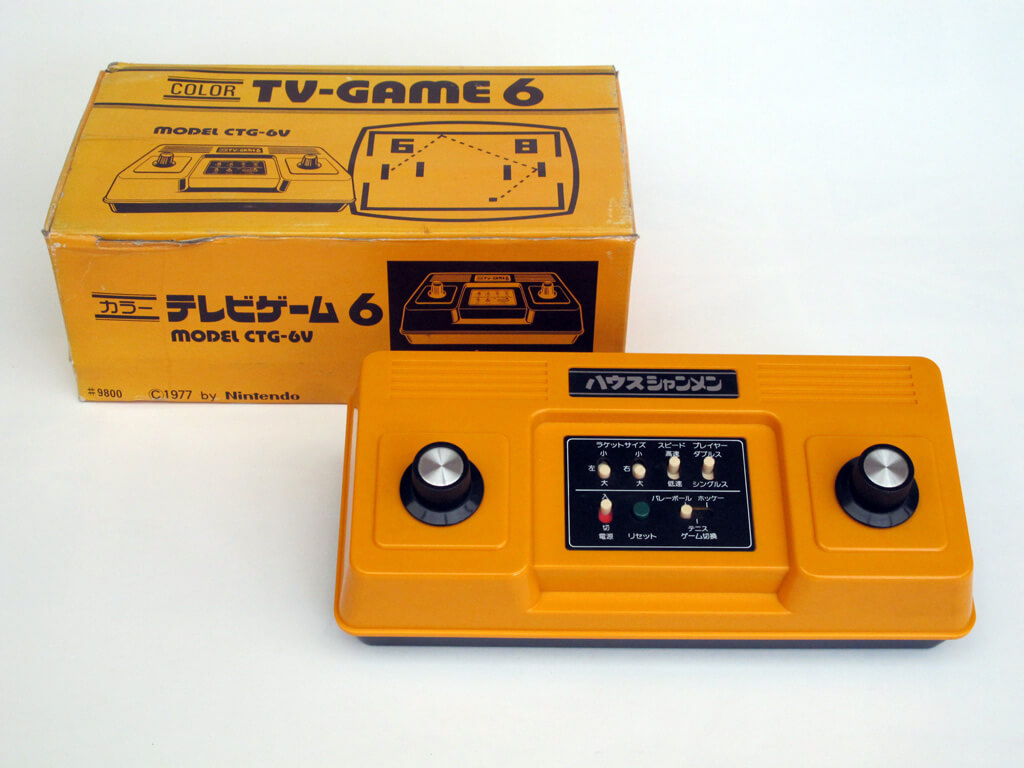
Color TV-Game 15 (1978) offered as many as 15 PONG variants and, unlike the first model of the console, it was equipped with two convenient controllers on long wires.

Color TV-Game Racing 112 (1978) offered players a completely new experience with a realistic car steering wheel and gearshift lever. In addition, it was possible to connect two additional controllers to the console and play with two friends.

Color TV-Game Block Breaker (1979) contained a variation of the popular game Atari's Breakout, where with the help of a racket you need to hit the ball into a group of colored tiles, breaking them. An interesting fact is that the case design of this Color TV-Game model is the first personal project of Shigeru Miyamoto. But we'll talk about it a little later.

Computer TV-Game (1980) contained an electronic version of the Reversi board game (also known as Othello), which could be played alone against a computer or together with a friend.

The first two models of Color TV-Game sold with a total circulation of 2 million pieces, and a total of the first Nintendo game console in all its variations sold just over 3 million pieces. This success allowed the company to significantly expand the divisions involved in electronic games.
Arcade machines and talent Shigeru Miyamoto
In parallel with the development of gaming consoles, Nintendo decided to come to grips with arcade game machines. Inside Nintendo, a special unit was even formed, the only direction of which was the production and sale of slot machines.
The very first arcade game released by Nintendo was EVR Race, a bulky machine for six players that showed horse racing on the screen and allowed people to bet on horses. The game was incredibly difficult, and the arcade machine constantly broke down and had to be repaired. The first pancake taught Nintendo that the world of arcade games is not as simple as it seemed from the very beginning.

The most famous Nintendo slot machines in the early 80s were Radar Scope (1980) - something between Space Invaders and Galaxian, and also Donkey Kong (1981) - a game that brought the company world-wide fame.
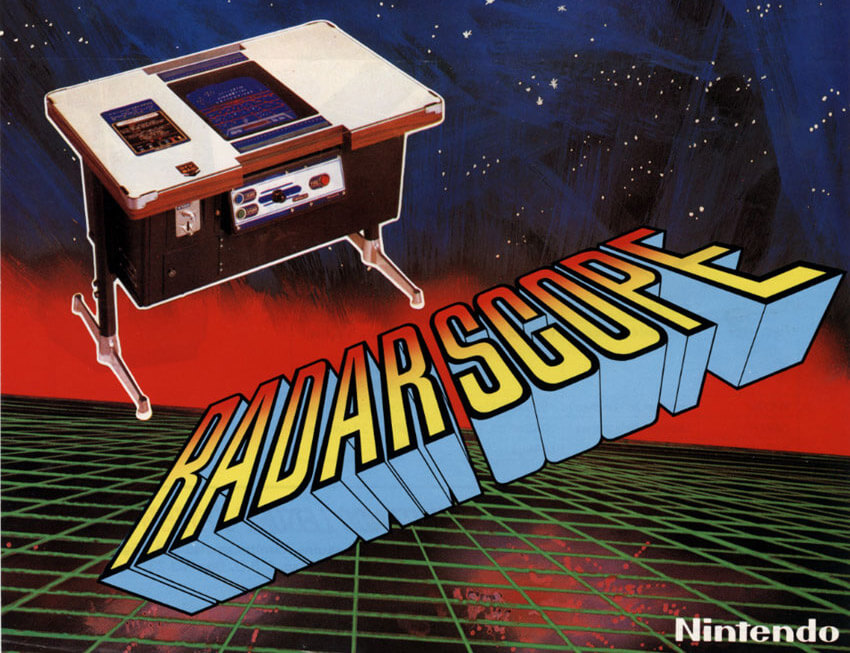
Donkey Kong is the first author's game of legendary game designer Shigeru Miyamoto. During the development of the game, he was inspired by cartoons about Sailor Popay, a fairy tale about beauty and a monster, as well as the Hollywood film King Kong. Together with Gumpey Yokoy, they created an incredible game project for those times. It even had a kind of plot inserts, telling how the evil gorilla of Dunk Kong kidnapped the girl, and the main character, a carpenter named Jumpman (then fashionable words like Pac-Man, Walkman, etc.), had to be saved from her clutches monsters. Few people then realized that Jumpman would in the future become the famous plumber Mario, who would make Nintendo one of the leaders in the electronic entertainment market.
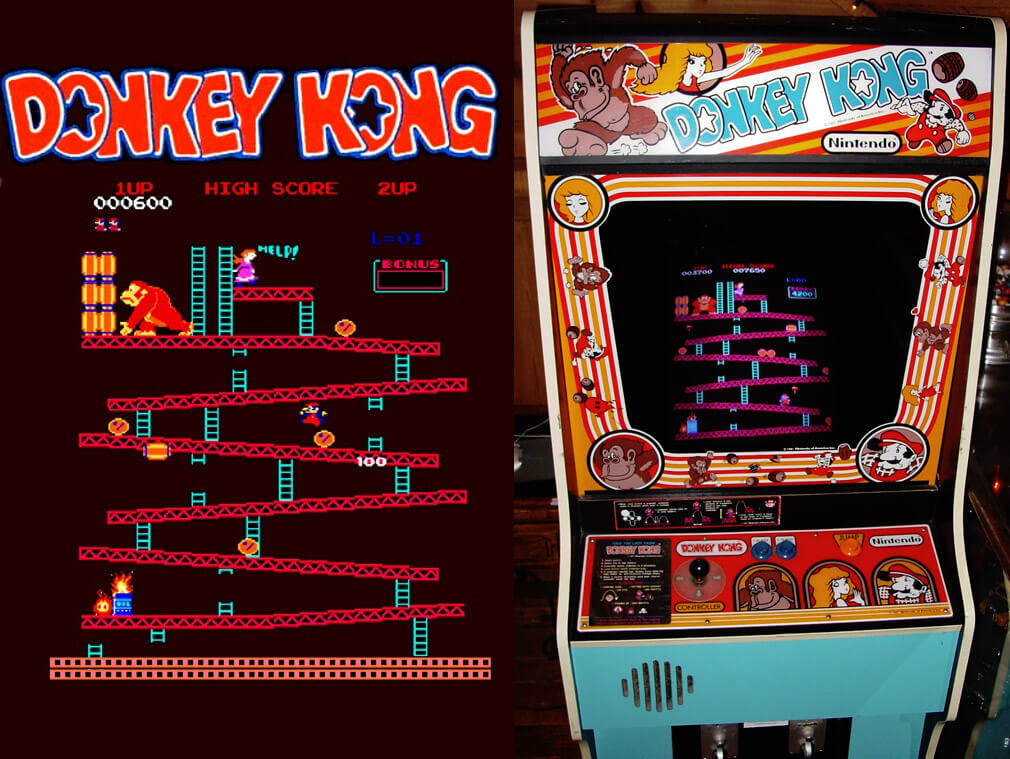
Donkey Kong has become so popular all over the world that Nintendo has even started selling the rights to its characters. The heroes of Shigeru Miyamoto appeared on the boxes with children's breakfasts, in cartoons, books and comics. The contract with the American publisher Coleco allowed porting the game to many other platforms, which brought Nintendo huge profits.

Game & Watch (1980)
The history of handhelds (portable or handheld gaming devices from the English. "Handheld") Nintendo originated in 1980, when the market was released the game under the straightforward name "Ball". This marked the beginning of a whole series of handheld video games under the label Nintendo Game & Watch, where the word Watch in the title was not just. Due to the low electricity consumption, the LCD display of these pocket toys constantly displayed the current time, so they could be used as a small electronic clock and even as an alarm clock.
Of course, this game console was invented and developed by none other than Gumpay Yokoy. The idea to create a handheld gaming console with an LCD display came to Gumpey all at once. He rode on a high-speed Japanese train and noticed that a bored business man was sitting next to him, who, having nothing else to do, poked buttons on his electronic calculator at random. After seeing this picture, the designer decided to create a compact device that works from round batteries for calculators (LR4x / SR4x), with which it would be possible to escape from boredom in similar situations.

The game “Ball” was not particularly intricate. A juggler (later Game & Watch mascot) was depicted on the screen, which was supposed to toss the falling balls, in time substituting their palms for them. As time progressed, the speed of the balls increased, and it became harder to play. For each ball kicked off the player accrued one point, and if all the balls fall to the ground - the game ends. On the handheld there were only two round control buttons - “left” and “right”, as well as three buttons for switching game modes and setting time. The first Game & Watch fell in love with gamers of the early 80s and sold about 250 thousand copies.

Nintendo's management quickly realized that it had stumbled upon a gold mine, and the company began to stamp new Game & Watch games one after another. Of course, the launch of several different games on one device was out of the question. After all, the entire character animation and interface elements were pre-printed on a segmented LCD screen, so there was simply no space left for other games. Therefore, each new game was an individual console designed specifically for it.
Game & Watch was released in several different versions, which differed by name, functionality and form factor. The first games were produced in the grays Silver (1980) and Gold (1981), since the front surface of the handhelds was either gold or silver.
They were replaced by the Wide (1981) and New Wide (1982) series, which featured a wider screen and increased console dimensions.

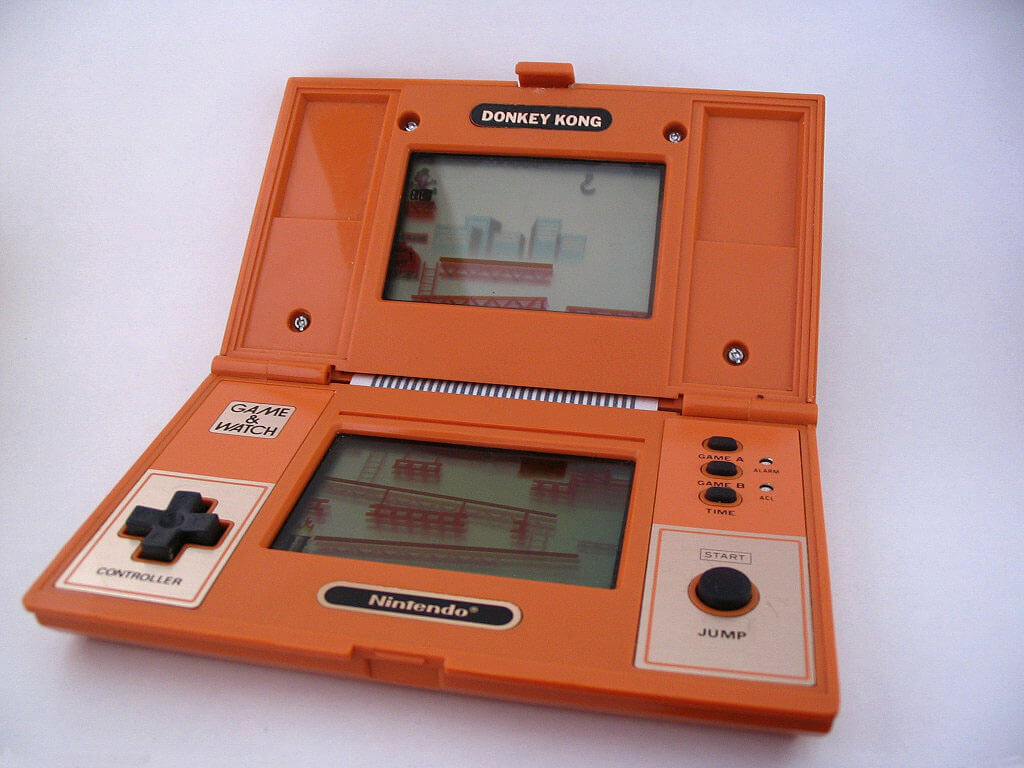
The Multi series (1982) added a second screen to Game & Watch, causing the console to become a clamshell.
The Panorama series (1983) used a system of light filters and mirrors to display a color image on the screen. At that time, it was impossible to implement an autonomous screen backlighting from tiny batteries for the “calculator”, so an external light source was used, which made the characters stencils on a tinted LCD screen colored and bright with the help of a light filter. A special mirror reflected the projection of the screen at the right angle into the player's eyes.

The Tabletop series (1983) was a tiny desktop copy of real arcade machines with their own controls. This console could hardly be called pocket, as it stood out from the total Game & Watch line with its size. But the console gave out a color image due to the fact that lamps and large batteries were placed in the case.

The Super Color series (1984) was notable for being able to produce a color image without using light filters, lamps, and mirrors, unlike Panorama and Tabletop. In addition, the console has acquired a vertical form factor.

The Micro VS System series (1984) introduced a multiplayer for two players to Game & Watch. Inside the console were hidden two round controllers on the wires, which could be taken out and give one of them to your friend.

The Crystal Screen Series (1986) had a transparent LCD display, under which various colored background images could be inserted.

Total sales of 60 different games of the Game & Watch series, which, by the way, continued to be officially issued until 1991, amount to approximately 43 million units. For fans of the classics, Nintendo still has a limited edition of some successful games of the Game & Watch series, but you cannot buy them in stores. These rare devices can be obtained only by purchasing Nintendo products and collecting bonus “stars”, which can then be exchanged on the website of the Japanese manufacturer for their very first pocket game “Ball”.

Many companies are inspired by the success of Nintendo in the field of handheld entertainment. Some tried to create something similar, while others simply brazenly copied Japanese ideas. The Soviet plant "Angstrem" for a long time produced and sold games of the series "Electronics IM" (IM is a microprocessor game), which were exact replicas and variations of Game & Watch toys. Many of you probably remember the famous toys “Well, wait a minute!” (1985) - an analogue of the Japanese game Game & Watch Egg, replacing the character with a wolf from a famous cartoon, or “Secrets of the Ocean” (1987) - an analogue of the game Game & Watch Octopus, they did not even redraw the character, but simply took everything ready.

In this straightforward way, the owners of domestic factories were able to illegally make huge fortunes by selling innocent pocket toys. The circulation of only one “Well, wait!” In 1985 amounted to 400,000 units. Nintendo, of course, was not aware of what was happening, as it was not interested in our market until the mid-90s.

The influence of Game & Watch on the gaming industry should not be underestimated. It was in the Game & Watch series of consoles that the first control scheme was applied with a coordinate D-pad (crosspiece) under the left hand and action buttons under the right. This approach was later transferred first to the Nintendo Entertainment System game controller, and then copied to almost all game consoles in controllers. By the way, the Nintendo DS handheld game console owes its clamshell form factor to the Game & Watch Multi game series.
In fact, Game & Watch was the first truly popular pocket console in the history of mankind. Yes, there were already attempts to create something similar, but none of these entertainment devices reached such heights.
In the next part we will talk about other Nintendo game consoles, and also discuss a lot of other interesting moments from the history of this Japanese company.
To be continued…
Content of the Nintendo Cycle:
[1] Nintendo and its game consoles
The article is based on materials .
Comments
Post a Comment